

My dad was a devoted paperback fantasy fan from way back, picking up the habit through J. R. R. Tolkien and moving on to the likes of Piers Anthony, Katherine Kurtz, and Stephen R. Donaldson.
I picked up the habit myself in 4th grade when I read The Hobbit. Then, on his suggestion, I picked up The Sword of Shannara. Only later did I attempt The Fellowship of the Ring, and from there the larger sweep of The Lord of the Rings.
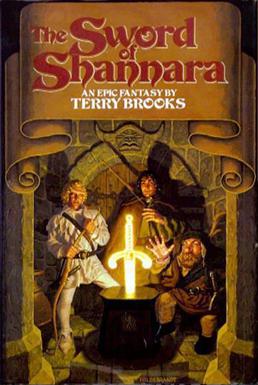
Looking back, I’ve realized something about the perennial “Which is better?” debate between Tolkien and Brooks: it’s framed all wrong.
Yes, I think Tolkien is better. Decidedly better, in most ways. But that doesn’t mean Brooks loses. It doesn’t mean one stays and the other gets dumped into literary exile. The assumption that art functions like a single-elimination tournament misses the point of how reading actually works—especially for young readers growing into more complex tastes.
What I experienced in the mid-80s wasn’t a rivalry. It was a progression.
The Gateway and the Cathedral
When I read The Hobbit, I encountered a story that felt complete, charming, and magical without being overwhelming. It had a quest, a dragon, riddles, maps, and songs. It felt like an adventure told to you by someone who knew the ending and wanted you to enjoy the ride.
When I moved to The Sword of Shannara, I found something familiar. A young, reluctant hero. A dark lord. A wise, enigmatic guide. A fellowship of companions. The bones of epic fantasy were there, but the prose was more direct, the pacing faster, and the themes easier to grasp at that age.
Only later did I try The Fellowship of the Ring. And that was different.
It wasn’t just a story. It felt like walking into a cathedral after growing up in a well-built but modest church. The architecture was more intricate. The ceilings were higher. The history embedded in every stone was palpable.
The difference between J. R. R. Tolkien and Terry Brooks isn’t merely about talent. It’s about ambition, depth, and intention.
Brooks tells a compelling heroic adventure. Tolkien constructs a mythic universe.
Why Shannara Worked So Well in 4th Grade
There’s a reason The Sword of Shannara clicked for me in 1984–85.
At ten years old, what matters most is narrative clarity and forward motion. You want stakes. You want danger. You want a hero you can latch onto quickly. Brooks delivers that with efficiency. The sentences don’t linger. The lore doesn’t overwhelm. The plot advances with clear momentum.
That relative simplicity isn’t a flaw—it’s a strength. Especially for younger readers.
In contrast, The Fellowship of the Ring opens with birthday parties, genealogies, songs, and long stretches of walking through landscapes thick with history. There are references to ancient wars you don’t fully understand yet. For a fourth grader, that density can feel like fog.
But here’s the crucial part: having read Brooks first made Tolkien easier to approach. I already understood the structure of epic fantasy. I knew what a dark lord was. I knew the archetype of the wise mentor. I knew that small heroes could carry large destinies.
Shannara gave me the framework. Tolkien filled it with depth.
Immersion vs. Accessibility
When people compare these works, they often focus on surface similarities—dark lords, magical artifacts, fellowship dynamics. That conversation has been done to death.
The more meaningful distinction lies elsewhere: immersion versus accessibility.
Tolkien’s worldbuilding isn’t decorative. It’s structural. Middle-earth feels ancient because it is layered with invented languages, genealogies, migrations, songs, and lost ages. The sense of time passing—the fading of magic, the diminishing of elves, the sorrow of departure—gives the narrative emotional gravity.
It’s not just that there is a map. It’s that the map implies civilizations that rose and fell long before the main story begins.
Brooks’ world, especially in the first Shannara book, functions differently. It supports the story rather than transcending it. The lore is there, but it does not carry the same archaeological density. The reader is not expected to feel the weight of millennia pressing on every decision.
And that’s okay.
Because immersion can be overwhelming if encountered too early. Accessibility opens the door.
Thematic Weight
One of the reasons I now prefer Tolkien is thematic complexity.
At its core, The Lord of the Rings wrestles with corruption, temptation, loss, mortality, and the passing of eras. The central conflict isn’t simply about defeating evil—it’s about enduring it without becoming it. The Ring isn’t just a weapon; it’s a test of character.
Power corrupts. Good intentions falter. Victory comes at a cost.
The tone is elegiac. Even in triumph, there is sadness. The elves depart. The age of magic wanes. Heroes cannot remain unchanged.
In contrast, The Sword of Shannara presents a clearer moral structure. Good and evil are more sharply delineated. The Sword itself reveals truth—exposing illusion rather than corrupting through temptation. The psychological and moral ambiguity is lighter.
For a younger reader, that clarity works beautifully. For an older reader, the layered moral struggle in Tolkien resonates more deeply.
It isn’t that Brooks lacks themes. It’s that Tolkien’s are heavier, more philosophical, and more enduring.
Growing Into a Book
Here’s something fascinating about reading across decades: books change as you change.
When I first read Tolkien, I was captivated by adventure. When I returned later, different elements rose to the surface—the melancholy, the sense of fading beauty, the quiet heroism of endurance rather than glory.
The older I get, the more the sorrow of Middle-earth feels central.
Brooks, by contrast, remains what he was for me: energetic, adventurous, earnest. There’s value in that consistency. But Tolkien grows with you. The subtext becomes more visible. The themes deepen.
That growth potential is part of what elevates Tolkien in my estimation.
But again, that doesn’t invalidate Brooks. It simply clarifies their different trajectories.
The False Binary
The internet loves binaries.
Which is better? Who wins? If you had to keep one, which would it be?
This way of framing art assumes competition. It assumes that appreciation is zero-sum. But literature isn’t a roster spot on a sports team. Reading one book doesn’t diminish another.
In fact, my appreciation for Tolkien is enriched by having read Brooks. Seeing the structural similarities makes Tolkien’s innovations clearer. Seeing the streamlined approach of Shannara highlights how much mythic density Tolkien packed into his work.
Without Brooks, I might not have approached Tolkien when I did. Without Tolkien, Brooks might not have written Shannara at all.
They are part of the same ecosystem.
The 1980s Context
Reading in the mid-80s mattered.
Fantasy wasn’t yet a mainstream cultural juggernaut. There were no streaming adaptations. No algorithmic recommendation engines. You found books through libraries, word of mouth, or the paperback spinner rack.
The Sword of Shannara had already helped prove that epic fantasy could sell in large numbers in the United States. It opened doors for commercial fantasy publishing. It helped create a market that allowed Tolkien’s legacy to remain vibrant in popular culture.
For a kid in 1984, these books weren’t intellectual talking points. They were portals.
And sometimes the first portal you walk through isn’t the grandest one. It’s just the one that’s open.
Preference Without Dismissal
So yes, I will say Tolkien is better.
The immersive worldbuilding. The linguistic invention. The mythic resonance. The thematic complexity. The emotional weight.
It’s more ambitious. More layered. More enduring.
But acknowledging that doesn’t require discarding Brooks. It doesn’t require sneering at accessibility. It doesn’t require rewriting childhood reading experiences as naïve or inferior.
The Sword of Shannara was worthy of my time in 4th grade. It still is. It tells a complete heroic story with clarity and heart. It invited me deeper into the genre.
The Lord of the Rings became the standard by which I measured epic fantasy afterward. It shaped my understanding of what worldbuilding could be.
One was a gateway. The other was a cathedral.
Both deserve to stand.
What “Better” Really Means
When we say something is “better,” what are we measuring?
- Craft?
- Influence?
- Emotional impact?
- Personal nostalgia?
- Intellectual ambition?
Tolkien wins in craft and influence. He wins in mythic depth. He wins in thematic layering.
Brooks wins in approachability and momentum. He wins as a gateway author. He wins in delivering a clean, driving quest narrative that doesn’t require a glossary.
Different metrics yield different answers.
And that’s fine.
The Long View
Looking back to the 4th grade, I don’t see a mistake in reading Brooks before Tolkien. I see preparation.
I see a reader learning the rhythms of epic fantasy before stepping into something denser. I see a ladder rather than a rivalry.
And I think that perspective matters.
Because art isn’t just about ranking outcomes. It’s about the role something plays in your development as a reader.
Shannara was a bridge.
Tolkien was the destination.
But you can’t fault the bridge for not being the city.
Final Thoughts
The “Which is better?” debate is tempting because it simplifies discussion. It forces a verdict. It gives us closure.
But the more interesting question is this:
What did each book do for you?
For me, in the mid-80s, one ignited the genre. The other defined its heights. One made epic fantasy digestible. The other made it transcendent.
I prefer Tolkien. Not because Brooks failed, but because Tolkien aimed higher and hit.
Yet I wouldn’t erase the experience of reading The Sword of Shannara at ten years old for anything. It was the right book at the right time. And sometimes that’s the most important measure of all.
© 2026 Christian A. Larsen. All Rights Reserved.


Leave a Reply