

The fall of Saruman—once Curumo the Wise, chief of the Istari—is one of The Lord of the Rings’ most poignant and haunting character arcs. A being of immense wisdom and power, sent by the Valar to guide Middle-earth, ends his journey not with a cataclysm or a redemption, but with a knife in the back from a worm of his own making. His spirit rises, dissipates on the wind, and vanishes.
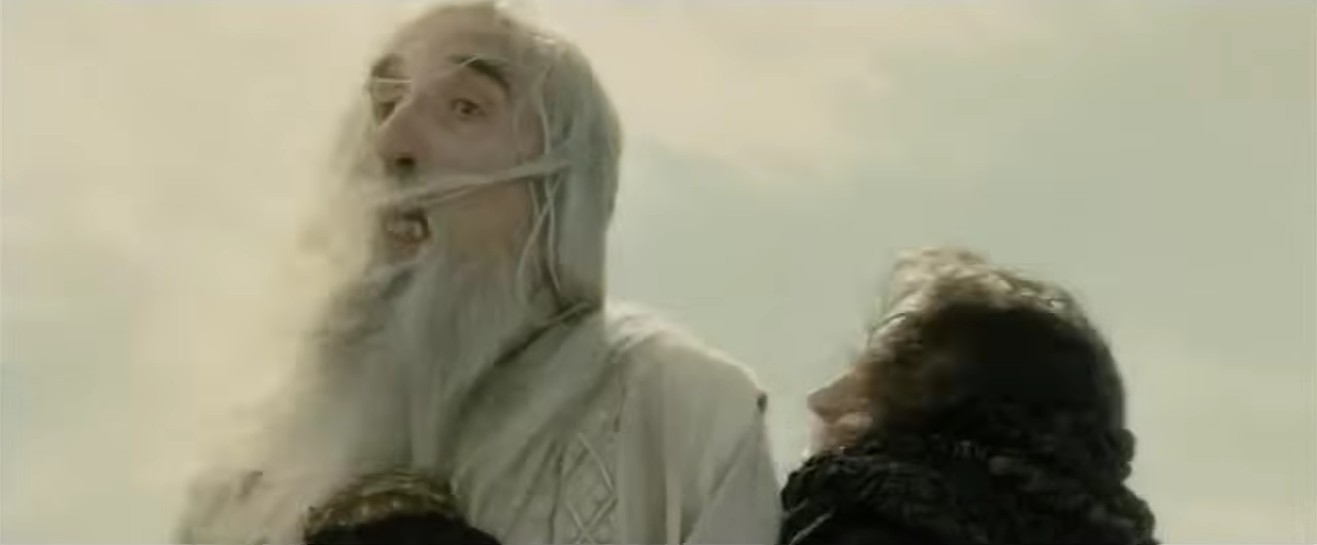
Many readers take this moment as final: Saruman is gone, his power broken, his existence ended. But is it really that simple?
What if the story isn’t over? What if Saruman, as a Maia—immortal and potent even in diminished form—did survive? Could he have re-embodied in the Fourth Age? And if so, what would that form be like?
This piece explores that possibility—not as mere fan fiction, but as a legitimate, textually-supported interpretation of Tolkien’s metaphysical framework. I will examine whether Saruman could have re-embodied, whether he had the will or means to do so, and what kind of figure he might have become in the shadowy edges of the Fourth Age.
The Nature of Saruman: Maia, Not Mortal
First, a reminder of what Saruman actually is. He is not a mortal man. He is a Maia, a lesser Ainur—spiritual beings created before the world itself. Like Gandalf (Olórin) and Sauron (originally Mairon), Saruman was sent into the world by the Valar, clothed in flesh, to guide the Free Peoples in the struggle against Sauron.
This physical form—the “raiment” of the Istari—was voluntarily assumed, and deliberately limited. They were incarnated in bodies that aged and suffered, to bind them to the concerns of those they served. But beneath that form, they remained powerful, immortal spirits.
So when Saruman is killed at Bag End, he does not cease to exist. His body is destroyed, yes. But his fëa, or spirit, persists.
The Rejection by the West: What It Means—and Doesn’t
Tolkien is quite clear that Saruman is rejected by the West. In one of the most memorable post-mortem moments in the trilogy, his spirit rises in a grey mist, lingers for a moment, and is blown away by a cold wind. The passage is often interpreted as a divine judgment, in which the Valar—or even Eru—refuse to receive him back.
But that rejection, while deeply symbolic, is not the same thing as annihilation. In Letter #156, Tolkien writes:
“His spirit went whither it was doomed to go. But that is not to nothing.”
This sentence leaves open enormous interpretive space. Tolkien doesn’t say Saruman was destroyed, only that he was denied return to Aman. His spirit goes “whither it was doomed”—perhaps not to Mandos, perhaps not to the Void, but still somewhere within the circles of the world.
If so, we are looking at a spirit that still exists, but is marooned: rejected by the West, too diminished for redemption, but not unmade.
This matches a larger metaphysical pattern in Tolkien’s world: Evil is rarely destroyed; it is displaced, diminished, or driven into shadow.
Sauron’s Re-embodiments: A Precedent
Now we must ask: if Sauron—a Maia like Saruman—could re-embody multiple times after catastrophic defeats, why couldn’t Saruman?
Sauron was:
- Defeated by Lúthien in the First Age,
- Drowned in the Downfall of Númenor in the Second,
- Destroyed by Elendil and Gil-galad in the Last Alliance,
- Finally undone only when the One Ring was destroyed.
Each of the first three times, he came back—weaker, yes, but still fearsome.
How? Because Sauron had not been judged or destroyed by the Valar. He had poured much of his power into the One Ring, and as long as it endured, so did his spirit. Even without a body, his will clung to Middle-earth.
So why couldn’t Saruman do the same?
If anything, Saruman had spent less of himself than Sauron. He had not invested his soul into a great ring. He had no phylactery tying him down. His physical body was destroyed, and his mission rejected—but there is nothing in the text that says his spiritual will was utterly broken.
In fact, one could argue that Saruman’s lack of total investment might have allowed him more flexibility to re-form.
Could He Have Re-embodied? Likely Yes.
So let’s follow this logic to its end:
- Saruman is a Maia: intrinsically capable of re-forming a body.
- His rejection by the West forbids his return to Aman, but does not annihilate his spirit.
- There is no textual evidence that his will was so shattered he could not eventually reconstitute himself.
Therefore, it is highly plausible—likely, even—that Saruman did what Sauron had done before him: linger as a disembodied spirit, gather what strength remained, and eventually assume a new form.
What Would That Form Look Like?
Here is where the interpretation gets rich. Tolkien associates spiritual corruption with loss of beauty and majesty. When Sauron falls with Númenor, he loses the ability to assume a fair form. His body becomes a dreadful one: tall, terrible, and wreathed in darkness.
Saruman, who once called himself “Saruman of Many Colours,” would no longer be the silver-tongued wizard cloaked in white. He would become something far more terrible, both in shape and in voice.
Perhaps he would appear:
- Hooded and cloaked, hiding a burned or withered form,
- Tall and skeletal, with a face like ash,
- Eyes glowing with malice—no longer rational, but magnetic in their fury.
His voice, once persuasive through wisdom and eloquence, would now be persuasive through fear and domination.
Like certain modern demagogues or populist tyrants, Saruman might trade rhetorical subtlety for sheer emotional force. He might not speak to reason or hope anymore—but to grievance, fear, and division.
His speech could shake the wills of men not because it promises order, but because it promises revenge.
A Saruman for the Fourth Age
So if Saruman re-embodied, what role would he play in a post-Sauron world?
Tolkien tells us little about the Fourth Age. But we know that evil does not disappear. The Men of the East and South are not all converted. Ambition, fear, and decay remain.
This would not be Sauron reborn—but a new, postmodern evil: not an overlord in armor, but a teacher of broken ideologies. Not a builder of towers, but a speaker in ruins. Not a sorcerer-king, but a dark prophet—a reflection of how evil evolves.
Conclusion: The Story May Not Be Over
Saruman’s apparent end is a spiritual tragedy. But it need not be the end. Tolkien gives us just enough ambiguity to imagine a continuation—one that aligns with his moral and metaphysical framework.
- He was not annihilated.
- He was not forgiven.
- But he was still a Maia—and Maiar, unless utterly unmade, endure.
What form he might return in, and what he might become, is not a contradiction of Tolkien’s world—it is a dark fulfillment of it.
Saruman’s re-embodiment in the Fourth Age is not only possible—it is chillingly likely.
What do you think? Could Saruman have risen again in shadow? And if he did, what would he seek: power, vengeance… or something worse? Let me know in the comments.
© 2026 Christian A. Larsen. All Rights Reserved.


Leave a Reply