

In the folklore of Northern Europe, few supernatural beings are as slippery, mysterious, and dangerous as the nick. Known variously as nix, nøkk, or neck, these spirits inhabit rivers, lakes, and streams, drawing humans into the water with hypnotic songs or sudden violence. While English folklore preserves the nicor, the Scandinavian tradition gives the nick a rich and distinctive cultural presence, reflecting the region’s intimate relationship with water, wilderness, and liminality.
Origins and Linguistic Roots
The word nick has deep Indo-European and Germanic roots:
- Middle High German: niches, nickes
- Old High German: nihhus, nichus
- Proto-Germanic: *nikwus, *nikwis
- Proto-Indo-European: *nigʷ-ō-s, from *neygʷ-, meaning “wash”
This etymology reflects the essential association with water, emphasizing both the physical environment and the spirits’ domain.
In Old English, the cognate is nicor, mentioned in Beowulf as a monstrous water creature, blending aquatic predation with supernatural traits. The Scandinavian forms—näck in Swedish, nøkk in Norwegian, and näck or nykk in Icelandic—adapted these early Germanic concepts to local landscapes, creating a robust and regionally varied mythos.
Nicks in Old Norse and Scandinavian Folklore
In Scandinavian sources, the nøkk / näck is a water spirit with shapeshifting and musical powers, inhabiting lakes, rivers, and streams. They occupy a liminal space between human and natural realms, embodying both the beauty and danger of freshwater landscapes.
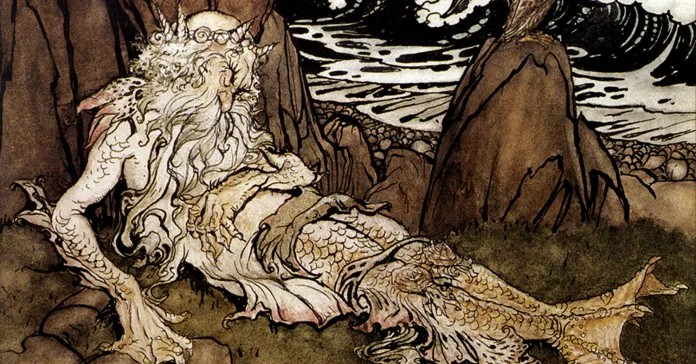
Physical Traits and Behavior
Scandinavian folklore describes the nicks in several ways:
- Shapeshifting: Nicks can appear as humans (often attractive young men), horses, or even fish. This ability reflects their liminal, unpredictable nature and their symbolic role as a bridge between worlds.
- Musical enchantment: Nicks are often depicted playing the violin or harp, their music irresistibly beautiful. Humans drawn to this music risk being lured into the water and drowned, reinforcing the archetype of dangerous seduction.
- Ambiguity of moral character: While often dangerous, nicks could also be helpful if respected or appeased. They might teach music or offer blessings to those who acknowledge them, reflecting the Scandinavian understanding of supernatural forces as morally ambivalent.
Habitat and Liminality
Scandinavian nicks are inseparable from the aquatic landscape:
- Rivers and streams: Fast-flowing waters were particularly associated with nicks, where the danger of drowning mirrors the spiritual peril.
- Lakes and ponds: Calm waters hide the nicks’ power, their beauty masking potential danger.
- Bridges and fords: Humans encounter nicks in transitional spaces, emphasizing their liminal function as guardians of thresholds.
This integration of nicks into natural topography illustrates the Scandinavian tradition of embedding spirits into the environment, using mythology to interpret, personify, and navigate potentially dangerous landscapes.
Nicks in Swedish Folklore
In Sweden, the nicks (näcken) are particularly prominent in tales collected by Asbjørnsen & Moe and in later ethnographic accounts:
- Malevolent musician: Näcken often appears as a handsome man playing a violin by the water’s edge. Humans drawn to his song risk drowning, a warning of nature’s seductive and destructive power.
- Shape-shifter: He can assume animal forms, including horses and cats, to lure victims or evade danger.
- Connection to water mills: In some regions, näcken was thought to inhabit water wheels or mills, linking him to both human industry and natural power.
Swedish folktales highlight the dual nature of the näcken: alluring yet deadly, capable of teaching skill or inflicting harm, emphasizing respect for water and the unknown.
Nicks in Norway and Denmark
In Norwegian and Danish folklore, the nøkk or nøkken exhibits similar traits but with local variation:
- Norwegian nøkk: Often male, associated with rivers and waterfalls. His music attracts children and unwary travelers, and he might pull victims into the water to drown. In some legends, he can be controlled or appeased through offerings or magical songs.
- Danish pokker / nix: Danish traditions maintain the aquatic domain but also stress the playful, trickster-like qualities, reflecting a broader Germanic influence.
- Connection to farms and domestic life: In certain rural areas, the nøkk could affect livestock health, linking water spirits to practical human concerns.
Across Scandinavia, the nix/nøkk/näcken embodies both danger and utility, reflecting the ambivalence of natural forces in human life.
Thematic Roles in Scandinavian Myth
Nicks serve several symbolic and cultural functions:
- Mediators of danger and morality: By luring humans, nicks warn against carelessness around water, reinforcing social and environmental caution.
- Guardians of liminal spaces: Appearing at bridges, fords, and water crossings, they remind humans of the thresholds between safety and danger, civilization and wilderness.
- Cultural repository of music and magic: The nicks’ musical talent represents both enchantment and danger, linking art to supernatural influence.
- Personifications of water hazards: In agrarian and seafaring communities, drowning, flooding, or rapid rivers were ever-present threats, and nicks offer a mythological framework for understanding and negotiating these dangers.
Evolution from Proto-Germanic to Scandinavian Context
The Scandinavian nicks evolved from early Germanic water spirits, as seen in Old High German nihhus / nichus and Middle High German niches, nickes. The Proto-Germanic *nikwus shows a consistent thematic focus on water and washing, suggesting the earliest cultural association was both physical and symbolic: water as life-giving yet dangerous, spirits as mediators of that duality.
As the concept migrated northward:
- Scandinavian myth enhanced musical and shapeshifting traits, emphasizing liminality and personal encounter.
- English and Celtic analogues (Old English nicor, Irish púca) share the aquatic domain but differ in narrative style, often emphasizing monstrous traits.
- Scandinavian nicks maintain a blend of beauty, danger, and moral ambiguity, reflecting the nuanced approach to spirits in Nordic folklore.
Comparison with Other Scandinavian Water Beings
Nicks coexist with other aquatic spirits in Scandinavia, illustrating a rich mythic ecology:
| Being | Traits | Relationship to Humans |
| Nix/Nøkk/Näcken | Shapeshifter, musician, liminal, dangerous | Can lure, teach, or kill |
| Sjörå/ Havsrå | Female water spirits, seductresses of fishermen | Both helpful and deadly |
| Fossegrim | Male waterfall spirit, teaches harp or fiddle | Beneficial if offerings are made |
| Water trolls | Larger, more monstrous beings | Primarily dangerous |
The nix/nøkk/näcken occupies a middle ground, less monstrous than trolls but more threatening than benevolent elves or dwarves, highlighting Scandinavian attention to gradations of supernatural threat.
Nicks in Modern Fantasy and Culture
Modern portrayals of nicks continue to draw from Scandinavian tradition:
- Fantasy literature: Authors like Johan Egerkrans and modern fantasy illustrators depict the nix/näcken as enchanting, liminal water spirits, preserving musical and shapeshifting traits.
- Music and media: In Scandinavian films, folk music, and operas, nicks appear as musical water beings, directly referencing their legendary connection to violin and harp.
- Role-playing games: RPGs such as Dungeons & Dragons or video games often feature “nixies” or “water spirits” inspired by Scandinavian myths, retaining ambiguous morality and aquatic habitats.
Modern fantasy tends to emphasize beauty and seduction over danger, reflecting contemporary reinterpretation, but the core Scandinavian traits—music, shapeshifting, liminality—remain.
Conclusion: The Scandinavian Nick
The Scandinavian nicks—nøkk, näcken, nix—are among the most distinctively Northern European mythic beings, reflecting centuries of interaction with rivers, lakes, and wild landscapes. They are musical, liminal, shapeshifting, morally ambiguous, embodying both the allure and danger of freshwater environments.
From Proto-Germanic *nikwus to Old Norse myths, through Swedish, Norwegian, and Danish folktales, the nick represents a complex engagement with water as a natural, cultural, and spiritual force. Unlike many fantasy creatures, their danger is rooted in natural reality: rivers are beautiful, necessary, and deadly, and the nick is their mythic personification. In Scandinavian tradition, the nick is neither wholly villainous nor wholly benign. Instead, it is a creature of warning, seduction, and instruction, embodying the nuanced relationship between humans and the unpredictable, liminal spaces of the natural world. Even in modern reinterpretations, the spirit’s musical allure, shapeshifting powers, and connection to water preserve the essence of centuries of Scandinavian folklore, ensuring that the nick remains a powerful symbol of liminality, nature, and enchantment.
© 2026 Christian A. Larsen. All Rights Reserved.


Leave a Reply