

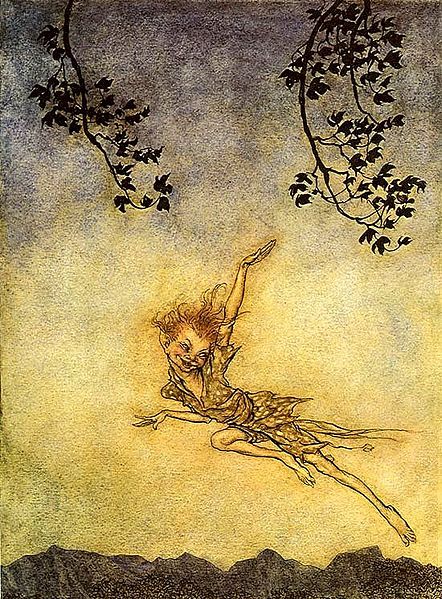
When we think of mischievous spirits in folklore, the English puck or Irish púca often comes to mind: playful, tricky, sometimes dangerous, sometimes helpful. But these beings have roots far deeper than the British Isles. Their lineage stretches back to Old Norse púki and the Proto-Germanic pūkô, linking them to centuries of Scandinavian belief in liminal, magical spirits. In a region defined by forests, mountains, and the harsh unpredictability of nature, these small trickster spirits served as both agents of mischief and mediators of moral and natural order.
Origins and Linguistic Roots
The Scandinavian origins of the puck are compelling. The Old Norse term púki appears in glosses and sagas to denote a small, mischievous spirit, often one associated with households or wild places. Scholars reconstruct the term to Proto-Germanic pūkô, cognate with Norwegian Bokmål puke and Danish pokker, as well as the English puck.
Linguistically, this suggests that the concept of a trickster spirit was widespread across early Germanic-speaking regions, long before the literary traditions of Shakespeare or English oral folklore. While the precise behaviors of púki in Old Norse sources are rarely elaborated, the term consistently conveys mischief, trickery, and liminality.
Some linguistic studies argue that *púk-/púki may be connected to Proto-Germanic ideas of pressure, poking, or disturbance, metaphorically reflecting the way these spirits “nudge” humans into chaos or challenge societal norms. In other words, from the very word, we can detect a cultural understanding: these were spirits that interfere with human life in unpredictable ways, neither entirely malevolent nor benevolent.
Púki in Old Norse and Scandinavian Folklore
Old Norse texts do not provide extensive stories about púki, unlike the rich catalogs of dwarves (dvergar) or elves (álfar). Yet the fragmentary mentions allow us to reconstruct a likely profile:
- Domestic and rural spirits: Púki could inhabit farms, forests, or crossroads. Their presence explains strange accidents, misplaced objects, or the sudden caprice of animals.
- Shapeshifting ability: Scandinavian folklore preserves hints that these spirits could take animal forms—perhaps a goat, horse, or black dog—to harass humans or travelers.
- Moral ambiguity: Like other Germanic supernatural beings, púki could be beneficial if respected and troublesome if offended. A farmer offering small gifts or maintaining rituals might keep a púki content; neglect could invite mischief.
While later English and Irish folklore expanded the personality and narrative of these beings, the Scandinavian foundation is more elemental, reflecting the liminal, unpredictable forces of nature rather than humanized characters with complex stories.
Comparative Liminality: Púki, Dwarves, and Elves
The Norse worldview featured several classes of small, magical beings: dwarves (dvergar), elves (álfar), and spirits like púki. While dwarves were craftsmen and elves linked to fertility and cosmic order, púki occupied a borderland of agency and unpredictability:
- Elves: Often associated with light (ljósálfar) or darkness (dökkálfar), elves influenced fertility, health, and luck, but usually on a larger, more cosmic scale.
- Dwarves: Skilled underground artisans, they created treasures and magical items. Their interaction with humans was generally transactional or narrative-driven.
- Púki: Smaller, more ubiquitous, and closer to the human-scale world. They influenced daily life, from herds and crops to domestic mishaps, embodying local, personal liminality rather than cosmic order.
In this way, the púki can be understood as the Scandinavian trickster spirit par excellence—a creature reflecting the hazards and surprises of daily life, not just the mythic universe.
Mythic and Cultural Roles
Though not well-documented in surviving sagas, the cultural role of the púki can be inferred:
- Enforcing social norms: Just as elves might reward proper respect for sacred places or dwarves might punish greed, the púki enforced domestic and communal behavior. Leaving food out for animals, maintaining order in the household, and respecting nature might all be subtly monitored by these spirits.
- Explaining natural events: Sudden livestock deaths, misplaced tools, or odd sounds at night could all be attributed to the capricious behavior of a púki. In agrarian societies, attributing the unpredictable to spirits provided a framework of understanding and ritual response.
- Liminal mediation: Appearing at crossroads, rivers, or forest edges, púki functioned as a threshold entity, reminding humans of the boundaries between settled and wild, domestic and magical, known and unknown.
The Scandinavian púki was not merely a figure of whimsy—it had practical and moral resonance in the communities that believed in it.
Shapeshifting and Magical Traits
Shapeshifting was central to the púki’s identity. Sources suggest a repertoire of forms and magical actions:
- Animal forms: Goats, horses, black dogs, or even birds. These forms could carry symbolic meaning: the black horse might lead travelers astray; the goat could steal milk or frighten livestock.
- Invisibility and stealth: Púki could operate unseen, creating mysterious disturbances without revealing their presence, reinforcing their liminality.
- Control over elements: Some accounts link them to small weather events or misbehavior of domestic animals, echoing the Norse understanding that spirits were embedded in natural forces.
This shapeshifting reflects the Norse belief in a fluid, mutable supernatural world, where beings could move between forms and planes of existence with ease.
Crossroads, Forests, and Thresholds
A recurring motif in both Old Norse and later Scandinavian-inspired folklore is the púki’s presence at thresholds:
- Crossroads: Symbolic of choice, uncertainty, and risk. A púki at a crossroads could mislead travelers or test them.
- Forests and wildlands: The Scandinavian landscape—with dense woods, fjords, and rocky terrain—provided natural hiding places for spirits. Here, the púki could play tricks or guard certain locations.
- Households and farms: In the domestic sphere, púki could move between the hearth, barn, and stable, influencing the safety and productivity of the household.
These locations emphasize the dual nature of the púki: connected to the natural and domestic world, ever on the boundary of human perception.
Scandinavian Analogues
Across Scandinavia, beings with similar traits appear:
- Swedish pocke: Refers to small mischief-making spirits.
- Norwegian puke: Historically both a term for a small spirit and an expletive, reflecting cultural ambivalence toward these forces.
- Danish pokker: Sometimes used euphemistically for troublesome spirits or bad luck.
The linguistic consistency across Scandinavia points to a shared mythic heritage: small, playful, or potentially dangerous spirits were recognized and named across the North Sea region.
Connections to Other Germanic and Celtic Folklore
The púki’s traits—mischief, shapeshifting, liminality—resonate with:
- Irish púca: Strongly connected to shape-shifting and wild rides, especially during Samhain. Likely a Celtic parallel influenced by Viking contact and Norse settlement in Ireland.
- English puck / Robin Goodfellow: Borrowed or adapted from Norse púki during the Viking Age and later Norman influence, merged with local English and Celtic traditions.
- Germanic kobolds and puks: House and mine spirits performing minor work or causing mischief.
In essence, the Scandinavian púki can be seen as the root stock of a pan-Germanic trickster-spirit motif, which then spread and evolved across Europe.
Gender and Social Roles
Old Norse and Scandinavian sources do not elaborate on púki gender as much as later English or Irish stories do. These spirits are generally male or gender-neutral, their role defined by behavior rather than gendered archetypes. They interact with humans in ways that enforce respect, caution, and proper conduct, whether in domestic life, agriculture, or travel.
Legacy in Modern Literature and Culture
While Scandinavian púki stories are sparse, their cultural and linguistic legacy is profound:
- Tolkien and fantasy literature: Early English literary treatments of Puck draw indirectly from Norse púki motifs of trickery, shapeshifting, and liminal magic.
- Folklore studies: Scholars reconstruct púki tales by comparison to English, Irish, and Germanic variants, highlighting Scandinavian roots.
- Popular culture: In Scandinavian-inspired fantasy, púki are often mischievous forest or household spirits, retaining the ambiguity and liminality of their origin.
Conclusion: The Scandinavian Trickster
Although the Old Norse and Scandinavian attestations of púki are fragmentary, the evidence—linguistic, folkloric, and comparative—reveals a rich, enduring concept of a trickster spirit deeply rooted in Northern European culture. These spirits were not merely whimsical; they were agents of moral and natural order, testing humans, explaining misfortune, and mediating the unpredictable forces of the natural world.
In the Scandinavian imagination, the púki exists at the edges: at crossroads, in forests, between night and day, domestic and wild. It is this liminality—the intersection of humor, danger, and mystery—that has allowed the concept to survive, adapt, and influence folklore far beyond Scandinavia, leaving traces in English literature, Irish myth, and modern fantasy. The Scandinavian púki reminds us that the spirit world is morally complex, playful, and intertwined with human daily life—a trickster as vital to Northern European imagination as elves, dwarves, or gods themselves.
© 2026 Christian A. Larsen. All Rights Reserved.
 Christian A. Larsen
Leave a comment