

When most people think of dwarves today, they likely picture stout, bearded craftworkers from modern fantasy novels, wielding axes and mining deep in enchanted mountains. But the Norse conception of dwarves is far older, stranger, and richer, rooted in centuries of Scandinavian myth and lore. In Old Norse mythology, dwarves are not just diminutive laborers; they are enigmatic beings whose very existence reflects the mysterious forces of the earth, craftsmanship, and the magical undercurrents of the cosmos.
Origins and Etymology: Where the Word ‘Dwarf’ Comes From
The English word dwarf descends from the Old English dweorg, which is closely related to Old Norse dvergr and Old High German twerg. Linguists reconstruct the Proto-Germanic form as *dwergaz, though some debate exists over whether the r sound arose through Verner’s Law, producing an alternate form, *dwezgaz.
The etymology of the term is closely tied to supernatural associations. Some scholars, including Anatoly Liberman, suggest a link between dwarves and mental disturbance, comparing the Germanic term to Modern English “dizzy” and noting that dwarves were sometimes believed to cause ailments of the mind. Others trace the word back to Proto-Indo-European roots such as *dheur- (“damage”) or *dhreugh- (“deception”), suggesting that dwarves were once conceptualized as dangerous or mischievous spirits. There is even a proposed connection to the Sanskrit dhvaras, a type of demonic being. Alternatively, linguist Guus Kroonen proposes a derivation from a verb *dwerganan, “to squeeze or press,” reflecting their subterranean, stone-bound existence.
The etymology hints at the dwarves’ original conceptualization: not necessarily short humans, but powerful supernatural beings with an ambiguous moral role, tied to both creation and calamity.
Dwarves in Early Scandinavian Myth: Beyond Short Stature
Contrary to modern fantasy depictions, early Norse sources rarely emphasize the dwarves’ small size. In fact, their height is largely irrelevant; what matters is their skill, wisdom, and magical abilities. They are traditionally linked to mountains, rocks, and underground spaces, living in secret beneath the earth’s surface. Their association with subterranean spaces reflects a symbolic connection to the forces of creation, craftsmanship, and hidden knowledge.
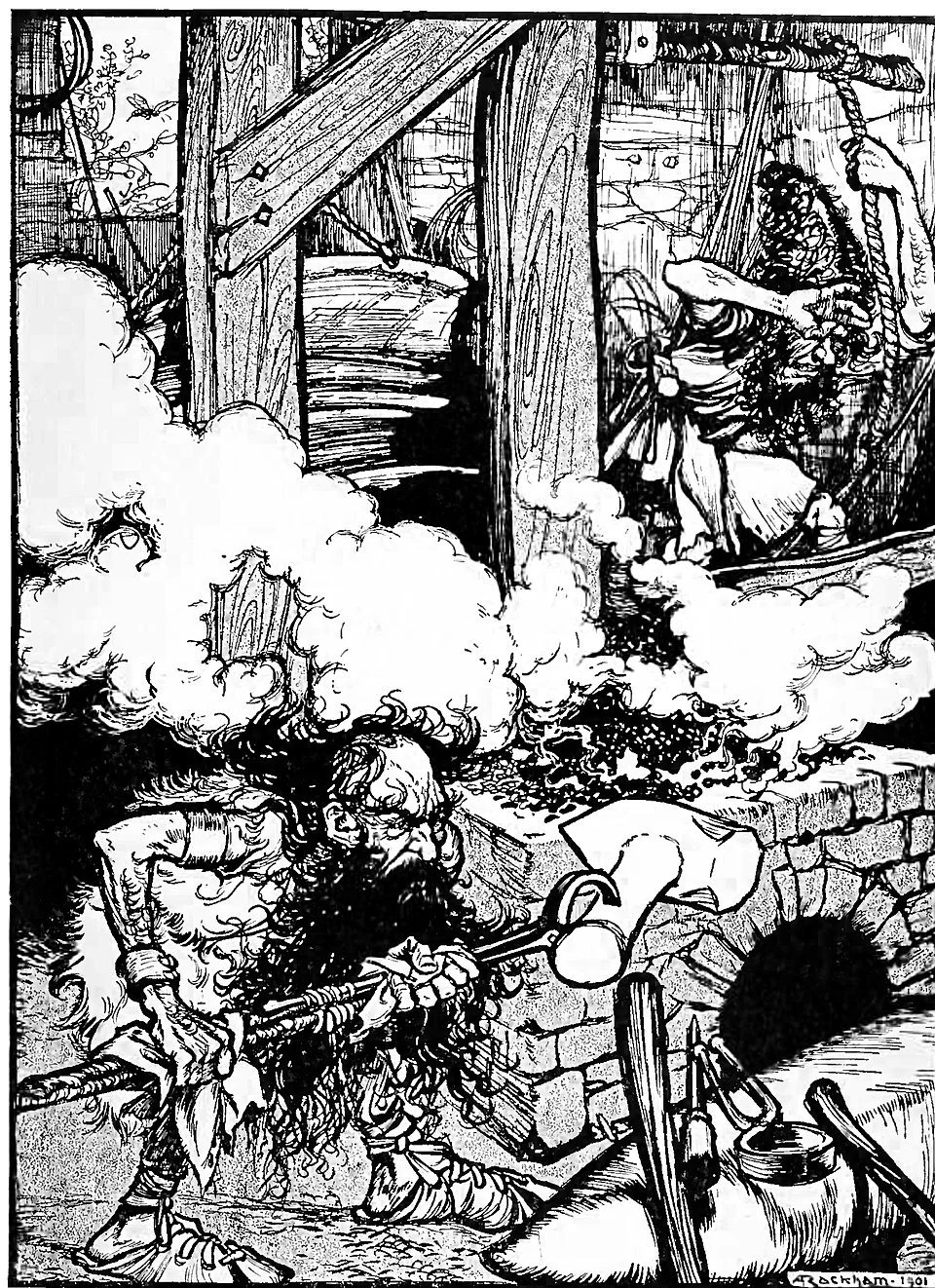
Dwarves were often conceived as skilled artisans and ore-shapers, capable of creating wondrous objects imbued with magic. In the Poetic Edda and Prose Edda, dwarves forge legendary artifacts such as Mjölnir, Thor’s hammer, and Draupnir, Odin’s gold ring. Their work demonstrates mastery not just of metal and stone but of cosmic forces, positioning them as intermediaries between gods and mortals.
Literary Sources: Völuspá and the Dvergatal
One of the most important sources for the names and roles of dwarves in Norse myth is the Völuspá (“Prophecy of the Seeress”), the first poem of the Poetic Edda. Within stanzas 10–16 lies the Dvergatal, or “Catalogue of Dwarves,” a list of dwarves with both individual names and symbolic roles. Some of the earliest mentioned dwarves include Mótsognir, “the mightiest,” and Durin, often considered the first of the dwarves.
The Dvergatal lists dozens of names, including Nýi, Niði, Norðri, Suðri, Dvalinn, and Dáinn, among others. Many of these names later inspired J.R.R. Tolkien’s Middle-earth Dwarves, illustrating how deep the roots of these myths run into modern literature. In the stanzas, dwarves are credited with making human likenesses in the earth, underscoring their role as creators and shapeshifters rather than merely miners or warriors.
Manuscript Variants: Þul Dverga and Laufás Edda
The Dvergatal is mirrored in other sources such as Þul Dverga, a þula (catalogue) that survives in multiple manuscripts, including Codex Snorra Edda A and B. This þula lists roughly 94 dwarf names, many overlapping with the Dvergatal but also containing unique entries. It appears alongside other þulur cataloguing kings, giants, and legendary beings, situating dwarves firmly within the mythic hierarchy of Scandinavian thought.
In the Laufás Edda manuscripts, many dwarf names appear alphabetically, showing scribal interest in preserving these beings not only poetically but systematically. The variations across manuscripts reveal the fluidity of Norse mythic tradition, where dwarves’ identities and numbers could shift depending on local or scholarly transmission.
Dwarves as Craftworkers and Magical Beings
Dwarves’ primary role in Norse myth is as masters of craftsmanship. They forge some of the most potent magical artifacts:
- Brokkr and Sindri, brothers who create Draupnir, Gullinbursti, and Mjölnir.
- Sons of Ívaldi, who craft Odin’s spear Gungnir and the ship Skíðblaðnir.
- Andvari, a shapechanging dwarf hoarding treasure, whose gold plays a pivotal role in the Völsung cycle.
Their abilities are not merely technical; dwarves imbue their creations with magical properties, affecting fate and the divine order. They also demonstrate trickery, cunning, and occasional malevolence, highlighting the Norse perception of dwarves as morally complex beings.
Dwarves interact with gods and mortals in ways that emphasize their cleverness. For example, Alvíss, a dwarf suitor of Thor’s daughter, is tricked into talking until sunrise and turned to stone. In these stories, dwarves are both powerful and fallible, bound by the cosmic rules of the Norse mythic worldview.
Names and Symbolism
Dwarf names in Norse tradition often carry layered symbolic meanings, reflecting traits, occupations, or natural elements:
- Dvalinn – From Old Norse dvala, “to remain or delay,” and Proto-Germanic dwalaz, “stunned” or “confused.” The name can be interpreted as “the dormant one,” evoking dreams, contemplation, or hidden knowledge.
- Bifur – Derived from Old Norse bifa, “to quake” or “shiver,” suggesting nervousness, trembling, or restless movement, highlighting a subtle or unsettled presence among the dwarves.
- Bofur – Possibly composed of Bǫ- (from búa, “to dwell” or “to live”) and -vurr (“man” or “inhabitant”), making the name roughly “dweller-man,” emphasizing their connection to the earth.
- Bombur – From Old Norse bumba, meaning “drum,” or metaphorically “potbelly” or “paunch,” conveying physicality, joviality, and a sense of presence or weight within dwarf society and legend.
- Fíli – Originates from Proto-Germanic finhlō/finhilō, meaning “file” or “rasp,” ultimately from Proto-Indo-European peyḱ- (“to adorn” or “to form”), underscoring dwarves’ skill, artistry, and mastery as expert craftworkers.
- Kíli – Possibly from Old Norse kjǫlr, “keel of a ship,” derived from Proto-Germanic keljaz. While dwarves are less associated with seafaring than elves or humans, poetic and object-based naming conventions make this etymology speculative, at best.
Other dwarf names may reference natural forces, magical attributes, or craftsmanship. Interestingly, some, like Gandálfr (“wand-elf”), hint at conceptual overlaps with elves, reflecting a shared mythological universe in which both beings occupy complementary roles.
Dwarves and Elves: Overlapping Identities
The boundaries between dwarves and elves in Old Norse sources are blurred. In the Prose Edda, the Svartálfar (“black elves”) live in Svartálfaheimr, the same subterranean realm associated with dwarves. Some names in the Dvergatal include the term álfr (elf), highlighting a conceptual link between these beings. Scholars debate whether early Norse people distinguished sharply between dwarves and elves or if the categories were fluid, overlapping, and symbolic.
This ambiguity reflects broader themes in Scandinavian myth: the blending of human-like intelligence with supernatural power, rooted in the unseen and the magical. Dwarves exist in liminal spaces—between earth and sky, creation and danger, helpfulness and mischief.
Dwarves and Cosmology
Dwarves also have a cosmic dimension. In the Poetic Edda, the first dwarves emerge from Ymir’s flesh or from primordial elements, linking them to the creation of the world itself. They are tied to the shaping of the physical and magical environment:
- Dwarves craft objects essential for the gods’ survival and the maintenance of cosmic order.
- Their subterranean dwelling aligns them with the hidden forces of the earth—minerals, treasures, and the secret workings of fate.
- Their ability to produce magical items makes them integral to the unfolding of events like Ragnarök, the end-times scenario in Norse myth.
Gender and Family
Early sources mostly describe male dwarves, though they are said to have sisters and daughters. Female dwarves become more prominent in later stories, though their roles are less elaborated. This gendered aspect reflects the broader Norse worldview, where social and mythical hierarchies were highly structured, yet flexible enough to accommodate magical and liminal beings.
Dwarves in Modern Culture
The enduring legacy of Norse dwarves is most evident in modern fantasy. J.R.R. Tolkien drew heavily on the Völuspá Dvergatal, using the names and traits of dwarves as the foundation for Middle-earth cultures. In Tolkien’s works:
- They maintain expert craftsmanship, deep knowledge of stone and metal, and a preference for subterranean dwellings.
- Names like Oin, Gloin, Ori, Nori, Dori, and Thorin are adapted from Norse sources, echoing the Völuspá Dvergatal while fitting Tolkien’s internal lore.
Terry Pratchett, in his Discworld novels, also reimagines dwarves in playful, culturally nuanced ways, demonstrating how Norse ideas continue to inspire writers.
Conclusion: Why Norse Dwarves Matter
Norse dwarves are more than quaint fantasy figures; they are central participants in Scandinavian cosmology, reflecting the Norse understanding of creation, magic, and the interplay of hidden forces. Through their craftsmanship, cunning, and moral ambiguity, dwarves connect humans, gods, and the natural world in a complex, symbolic network.
From the Dvergatal of Völuspá to the Þul Dverga and Laufás Edda, these beings occupy a liminal space that continues to fascinate scholars and storytellers alike. They are creators, tricksters, and custodians of secret knowledge, their stories echoing the Norse reverence for skill, resourcefulness, and the mysteries that dwell beneath the earth.
In a sense, dwarves remind us that the unseen forces—whether in myth, nature, or imagination—shape the world as much as the visible actors. Their legacy is both historical and literary, proving that even in the deepest mines and the hidden corners of Scandinavian forests, stories of power, craft, and cunning endure.
© 2026 Christian A. Larsen. All Rights Reserved.


Leave a Reply