

I started playing Advanced Dungeons & Dragons when I was six or seven, sitting on the floor with my older brother and his friends. They had all the advantages—a paladin with a gleaming sword, a magic-user with spells that could level mountains, a cleric who seemed to have a direct line to the gods—and I was a lowly thief, sneaking along in the shadows, picking locks, and finding my own small victories. Yet for me, it didn’t matter. I was in the game, part of the adventure, and that was enough.
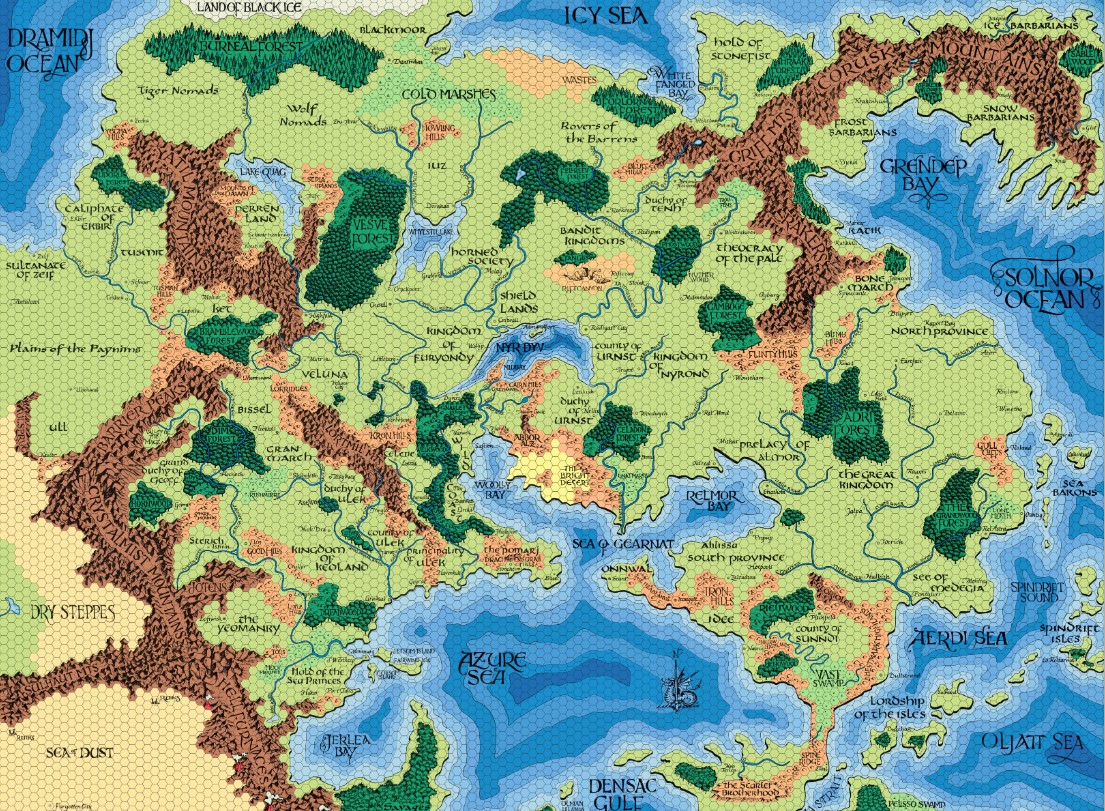
My first characters were small pieces of a much larger imagined world. I played a thief from the Rovers of the Barrens, wandering the wilds and scavenging for treasure, while my brother’s character hailed from the Shield Lands, trained to defend towns and borders. Together, we created our own stories—once even building a keep on an uninhabited island in the Densac Gulf, declaring ourselves kings of our tiny domain for the evening. Those moments of invention and shared triumph, powered purely by imagination, are what make early AD&D play unforgettable.
I still remember rolling dice late into the evening, poring over character sheets, and losing myself in the worlds we imagined. Adventures like The Keep on the Borderlands or entirely homebrewed scenarios taught me that the joy of D&D came less from rules or stats and more from creativity and shared storytelling.
It was later, as I discovered the Greyhawk campaign setting, that I understood what a truly rich fantasy world could feel like. Greyhawk wasn’t just a backdrop for adventures—it was a living, breathing world designed to inspire imagination, exploration, and heroism. Even decades later, it’s the setting I remember most vividly from the earliest days of AD&D.
Gary Gygax’s Original Vision
Gary Gygax didn’t just create a game; he created a world. Greyhawk was designed to serve the game itself, not to dazzle with spectacle or tie into novels and media. Every kingdom, city, and dungeon has a purpose. Towns function as hubs for adventure, wilderness regions hide secrets, and factions and politics make the world feel alive.
Unlike some later settings that prioritize story over mechanics, Greyhawk strikes a delicate balance. It’s a world you can explore casually or campaign across with intricate plots, all without breaking the rules. Every character—fighter, thief, cleric, magic-user—has a place to shine. That balance between structure and freedom is what makes Greyhawk timeless.
Flexibility and Player Agency
One of Greyhawk’s greatest strengths is its flexibility. Unlike settings with rigid storylines, Greyhawk acts as a canvas. Dungeon Masters can add cities, invent factions, or shift regions while maintaining the world’s internal logic. The map adapts to the story, rather than forcing the story to fit the map.
This flexibility mirrors the early days of my own play. Our homebrewed keep in the Densac Gulf, our Rovers and Shield Lands characters, even the way we improvised challenges—all of it could coexist in a setting like Greyhawk. The world absorbs player creativity, making it ideal for both structured campaigns and spontaneous adventures.
Depth of History and Culture
Greyhawk isn’t just a collection of maps and dungeons—it has history, politics, and culture. The Flanaess, the heart of the setting, is full of nations with distinct identities, governments, and conflicts. From the militaristic Great Kingdom to the mercantile lands of Nyrond, the political landscape feels real and consequential.
This depth enriches role-playing. Characters aren’t just adventurers—they are participants in a living world. A thief might steal from a corrupt noble, a magic-user might navigate rivalries at the University of Magic, and every choice can ripple outward. That sense of consequence is rare and makes Greyhawk more than just a backdrop; it’s a world that feels alive.
Iconic Locations That Spark Imagination
Greyhawk is full of legendary locations. Greyhawk City, with its bustling markets, dangerous slums, and looming castle, offers endless storytelling possibilities. The Temple of Elemental Evil is the quintessential dungeon crawl—twisting corridors, deadly traps, and moral ambiguity in every corner.
And yet, these locations aren’t prescriptive. They’re adaptable. You can run a campaign entirely within the Flanaess or explore the Unknown Regions or the jungles of Amedio. Greyhawk gives the DM tools but never restricts creativity. It’s a world designed to inspire adventure, not dictate it.
Classic Monsters, Magic, and Mystique
Greyhawk introduced some of AD&D’s most iconic monsters and magic. Beholders, demiliches, and countless other threats first appeared in Greyhawk materials. Magic items and artifacts often have deep lore, grounding them in the world rather than treating them as mechanical props.
Take the Rod of Seven Parts, for example. It isn’t just a powerful artifact; it has history, enemies, and consequences built into its story. Wielding it isn’t just about mechanics—it’s about interacting with Greyhawk itself. That kind of integration between world and game elevates every adventure.
Old-School Charm
Greyhawk has an unmistakable old-school charm. It’s unapologetically medieval, with rough edges that spark creativity. Unlike later settings that sometimes hand-hold players with extensive lore, Greyhawk encourages improvisation. DMs and players co-create the story, making every adventure unique.
That was exactly what drew me to AD&D as a child. My thief may not have had the best sword or spells, but cleverness and timing mattered just as much as stats. The world rewarded ingenuity, and that sense of unpredictability is part of its enduring appeal.

A Lasting Influence
Greyhawk’s influence on D&D is enormous. Many conventions we take for granted—organized factions, complex political landscapes, moral ambiguity—originate here. Without Greyhawk, AD&D might have remained a collection of dungeons and monsters with little cohesion.
Even after Gygax left TSR and other settings like Forgotten Realms rose to prominence, the DNA of Greyhawk persisted. Its balance of dungeon exploration, wilderness adventure, and political intrigue shaped nearly every D&D world that followed.
A Playground for Imagination
What makes Greyhawk special is its versatility. It can host dungeon crawls, epic quests, political intrigue, or simple adventures of survival and exploration. The setting doesn’t dictate the story; it supports it. That universality makes it timeless.
Even though I don’t really play anymore, the memory of sneaking past traps, building keeps on uninhabited islands, and imagining epic adventures remains vivid. Greyhawk isn’t just a game world; it’s a testament to the power of imagination.
Nostalgia and Lasting Magic
Greyhawk captures the magic of early AD&D in a way no later setting has fully replicated. Sitting on that bedroom floor, rolling dice, and watching the story unfold was pure wonder. That feeling—the thrill of possibilities, the joy of exploration—is what Greyhawk delivers, even decades later.
It’s more than nostalgia. It’s a reminder of why these games mattered, why they captured imaginations, and why Greyhawk remains the standard for what a fantasy world in AD&D can be.
Conclusion: Greyhawk as the Heart of AD&D
Greyhawk isn’t just a setting; it’s a philosophy of play. It balances structure and freedom, history and possibility, danger and delight. It teaches that cleverness, creativity, and collaboration matter just as much as combat prowess or magical power.
Even if I don’t roll dice much these days, Greyhawk still feels like home. It’s a world that encouraged exploration, rewarded ingenuity, and offered endless adventure. That sense of possibility, that spark of imagination, is what makes Greyhawk, to me, the ultimate setting in Advanced Dungeons & Dragons.
It’s not just a game world—it’s a reminder of the joy of play, of storytelling, and of the worlds we carry with us long after the dice stop rolling.
© 2026 Christian A. Larsen. All Rights Reserved.
 Christian A. Larsen
Leave a comment