

Across Europe and much of Asia, ancient mythologies share striking similarities: a thunder-wielding sky god, a radiant dawn goddess, divine twins, and deities governing fire, wind, earth, and fate. These parallels are widely believed to descend from the religion of the Proto-Indo-Europeans (PIE), a prehistoric people whose language gave rise to Greek, Sanskrit, Latin, and the Germanic languages.
Linguists have reconstructed many PIE roots and even fragments of their mythological worldview. Deities such as the sky father Dyēus, the dawn goddess H₂éwsōs, and the thunder god Perkʷūnos appear reflected across later traditions.
But what if those gods had remained central within the Germanic branch? What if their names had evolved continuously through Proto-Germanic, Old English, and later stages of English?
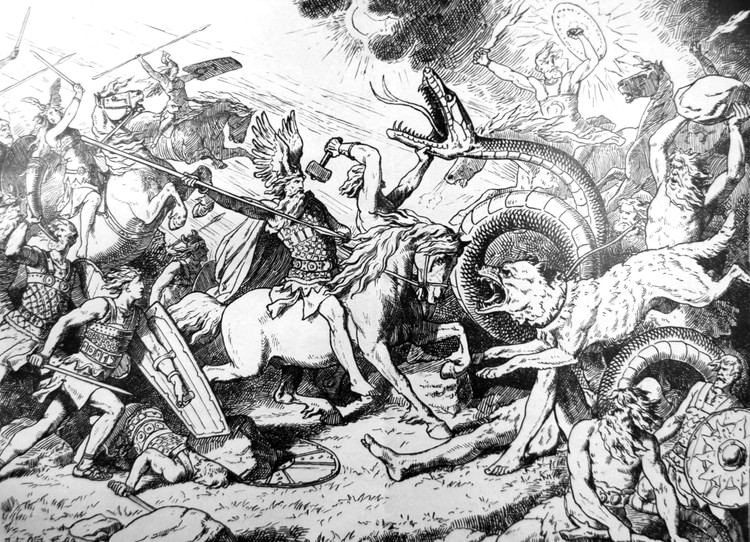
This article imagines that alternate linguistic history. Using known sound changes, it speculatively reconstructs how Proto-Indo-European divine names might have evolved into English-like forms.
I should emphasize that I am not a professional historical linguist. I am a hobbyist with an interest in Indo-European languages and mythology. The reconstructions below are therefore speculative linguistic thought experiments, not scholarly reconstructions.
They attempt only one thing: to imagine how ancient names might plausibly sound in English today if they had followed the normal phonological evolution of the language.
A Brief Guide to Sound Change
To reconstruct deity names across time, we rely on historical linguistics — specifically how sounds shifted from PIE into its descendants. Key processes include:
1. From Proto-Indo-European to Proto-Germanic
- Grimm’s Law: Voiced stops became voiceless (e.g., b → p, d → t) and voiceless stops became fricatives (p → f, t → θ)¹.
- Loss of laryngeals: PIE’s h₁, h₂, h₃ disappeared or modified nearby vowels².
- Vowel simplification: PIE diphthongs were often reduced to single vowels.
2. From Proto-Germanic to Old Norse & Old English
- Stress shift: Stress moved to the first syllable, weakening final syllables³.
- i-Mutation: Front vowels shifted under the influence of i or j in later syllables⁴.
3. From Old English to Modern English
- The Great Vowel Shift: Long vowels were raised or diphthongized between 1400–1600⁵.
- Loss of inflectional endings: English became more analytic over time.
- Simplification of consonant clusters: Final consonants and syllables were dropped or smoothed.
The Pantheon in English: A Linguistic Mythology
Each deity below is derived from a reconstructed PIE name, following sound changes through Proto-Germanic, Old Norse or Old English, and into Modern English.
Water God: Aff
- PIE: *H₂epom → Proto-Germanic: Afą → Old Norse: Afa → Old English: Āf → Modern English: Aff
Aff rules rivers, lakes, and seas. His name reflects the PIE root ap- (“water”)⁶. In English, Aff is stark, elemental, and holy — his worship might involve springs and baptismal rites.
Love Goddess: Brin
- PIE: *PriHyéh₂ → PGmc: Prijunō → ON: Brýna → OE: Bryne → Brin
Derived from the PIE root prī- (“to love”)⁷, Brin is the goddess of desire, passion, and fertility. In Modern English, her name is sleek and soft — fitting for a deity of beauty and devotion.
Earth Goddess: Degome
- PIE: *Dʰéǵʰōm (“earth”) → PGmc: Deġōm → ON: Dǫgumi → OE: Deguma → Degome
Degome embodies the fertile land and the final grave. Her name retains the PIE root dʰéǵʰōm (“earth” or “ground”)⁸. She is worshipped in groves and honored during planting and harvest.
Storm God: Fercken
- PIE: *Perkʷūnos → PGmc: Ferkunaz → ON: Fǫrkinn → OE: Ferccen → Fercken
Fercken is the thunder-wielder, akin to Thor. Grimm’s Law transforms PIE p to f, and kʷ to k. The name Fercken evokes raw power — his rites include bonfires and iron hammers⁹.
Shepherd God: Fowsen
- PIE: *Péh₂usōn → PGmc: Pūzōn → ON: Fúsinn → OE: Fūsan → Fowsen
Fowsen is a gentle guide, guardian of flocks and souls. From PIE peh₂- (“to protect, feed”)¹⁰, he is a divine shepherd, leading both sheep and spirits with care.
Dawn Goddess: Yestre
- PIE: *H₂éwsōs → PGmc: Austrōn → ON: Jǫstri → OE: Ystre → Yestre
Yestre represents new beginnings. Her name survived in Eostre — the source of the modern word Easter¹¹. She brings light and rebirth, with rites during spring equinox.
The Fate Goddesses: Clode, Leath, and Treva
- PIE: *Klōtéh₂ → Clode, *Dl̥gʰ-tih₂ → Leath, *n̥-trep-eh₂ → Treva
These three weave, measure, and cut the threads of life. Their names reflect ancient PIE roots for spin, long, and turn¹². Like the Norse Norns, they are revered and feared.
Fire God: Eggner
- PIE: *H₁n̥gʷnis → PGmc: Angwīniz → ON: Ǫgnir → OE: Egnor → Eggner
From PIE n̥gʷn- (“fire”)¹³, Eggner rules flame — hearth, forge, and purification. His worship includes sacred fires and offerings of metal.
Wild God: Raddle
- PIE: *Rudlos (“untamed”) → PGmc: Rōdlaz → ON: Rǫdli → OE: Rodle → Raddle
Raddle is chaos incarnate — forests, beasts, and frenzy. His cult involves masks, dance, and ecstatic rites, similar to Pan or Dionysus.
Horse Goddess: Searne
- PIE: *Ser-n̥-yuH₂ → PGmc: Sērnuz → ON: Særna → OE: Searn(e) → Searne
Searne blesses horses and riders. Her name stems from the PIE root for “to flow, move” — reflecting grace and mobility¹⁴.
Consort Goddess: Teune
- PIE: *Diwōnā → PGmc: Tīwōnō → ON: Týna → OE: Tiwene → Teune
Teune, partner of the sky god, symbolizes divine union. Her name connects to Dyēus (PIE for “sky god”), reinterpreted through Germanic sound patterns¹⁵.
Cattle God: Wellen
- PIE: *Welnos → PGmc: Wēlnuz → ON: Vélnir → OE: Welna → Wellen
Wellen oversees herds and abundance. His PIE root wel- means “to wish, choose, or bless”¹⁶. He is invoked in commerce and pastoral rites.
Wind God: Wey
- PIE: *H₂weh₁yús → PGmc: Wīhₓa → ON: Vǫi → OE: Wēa → Wey
Wey is air and breath — life itself. His name echoes the PIE root weh₁- (“to blow”)¹⁷. Poets and sailors pray to him.
Smith God: Wolken
- PIE: *Wl̩kānos → PGmc: Wulkaz → ON: Volkinn → OE: Wolcen → Wolken
Wolken crafts divine tools. Like Vulcan, he is a blacksmith god. His name evokes fire, metal, and industry¹⁸.
Starlight God: Werren
- PIE: *Worunos → PGmc: Werunaz → ON: Vǫrun → OE: Werne → Werren
A mysterious, sky-bound god. Werren watches the heavens. His name is related to Uranos in Greek — an ancient celestial deity¹⁹.
Divine Twins: Hench and Hoss
- PIE: *Ḱanḱestos → Hangistaz → Hestr → Henġest → Hench
- PIE: *Kréh₂tis → Hrōsiz → Hross → Hros → Hoss
These twin horsemen embody loyalty, duality, and fate. Names survive in Hengest and Horsa, legendary Anglo-Saxon leaders.
Welfare God: Ermin
- PIE: *H₂eryo-men → PGmc: Ermunaz → ON: Jǫrmunr → OE: Eormen → Ermin
Ermin ensures peace and prosperity. Anglo-Saxon kings took names like Eormenric in his honor²⁰.
Moon God: Moyne & Sun Goddess: Swale
- PIE: *Meh₁not → Mēnōn → Máni → Mōne → Moyne
- PIE: *Seh₂ul → Sowilō → Sól → Sweġel → Swale
Moyne governs dreams and time, while Swale brings warmth and sight. These celestial siblings orbit the mythology as cosmic rulers.
Sky God: Tue
- PIE: *Dyēus → Tīwaz → Týr → Tiwe → Tue
Tue is the high god — lawgiver, warrior, and patriarch. His name lives on in Tuesday (“Tiwe’s Day”)²¹.
Conclusion: A Lost Pantheon in Our Language
Language holds memory. Through phonological shifts and religious evolution, we glimpse a forgotten pantheon that could have been native to English: Aff, Brin, Degome, Fercken, Fowsen, Yestre, Clode, Leath, Treva, Eggner, Raddle, Searne, Teune, Wellen, Wey, Wolken, Werren, Hench, Hoss, Ermin, Moyne, Swale, and Tue.
This is not fiction, but linguistic mythology. These deities might have filled our temples and lifted our tongues had cultural winds shifted only slightly. Of course, I may be — and probably am — misreading those winds. Tell me in the comments where my grasp of linguistics went off course.
© 2026 Christian A. Larsen. All Rights Reserved.
Footnotes
- Fortson, Benjamin W. Indo-European Language and Culture: An Introduction. Wiley-Blackwell, 2010. See Chapter 7 (Grimm’s Law).
- Beekes, Robert S.P. Comparative Indo-European Linguistics. John Benjamins, 2011.
- Ringe, Don. From Proto-Indo-European to Proto-Germanic. Oxford University Press, 2006.
- Hogg, Richard. A Grammar of Old English: Volume 1, Phonology. Wiley-Blackwell, 1992.
- Lass, Roger. The Cambridge History of the English Language, Volume 3. Cambridge University Press, 1999.
- Watkins, Calvert. The American Heritage Dictionary of Indo-European Roots, 2nd ed., Houghton Mifflin, 2000.
- Mallory, J.P., and Adams, D.Q. The Oxford Introduction to Proto-Indo-European and the Proto-Indo-European World. OUP, 2006.
- Ibid., p. 100.
- Ibid., p. 135.
- Watkins, p. 60.
- Bede, De Temporum Ratione (725 CE) — earliest mention of Eostre.
- Mallory & Adams, p. 156.
- Watkins, p. 68.
- Ibid., p. 78.
- Fortson, p. 48.
- Watkins, p. 98.
- Ibid., p. 104.
- Beekes, p. 127.
- Mallory & Adams, p. 88.
- Ringe, p. 201.
- Hogg, p. 229.
 Christian A. Larsen
Leave a comment