

The Lord of the Rings by J. R. R. Tolkien is full of mystery and tension, and few brief encounters illustrate this better than the moment when a Black Rider comes to the house of the Gaffer in Hobbiton, asking that a message be delivered to Frodo Baggins. The Gaffer refuses, and the Rider departs with the chilling remark that Frodo will “know that I have been here.” The reader is never told what the message would have said.
Yet Tolkien’s narrative provides enough clues to make a careful and reasonable inference. When the Nazgûl’s behavior throughout the early chapters of The Fellowship of the Ring is considered closely, it becomes likely that the message would not have been a threat at all. Instead, it would probably have been a polite, business-like request designed to draw Frodo into conversation—possibly accompanied by the promise of a reward. Just as importantly, it would almost certainly have avoided any mention of the Ring.
Nazgûl Methods: Inquiry Before Terror
When the Black Riders first enter the Shire, they do not immediately behave like the terrifying specters readers later encounter at Weathertop. Instead, they begin by quietly asking questions.
The Rider who questions the Gaffer does not burst in or issue commands. He asks about “Baggins” and presses for information in a controlled manner. Likewise, Farmer Maggot later recounts that a Rider questioned him about Frodo and even attempted to bribe him:
“He offered me gold if I would tell him more.”
This moment reveals an important pattern: the Nazgûl are willing to offer inducements for cooperation. They are not simply instruments of brute force but agents of investigation. Their method, at least in the early stages of the hunt, appears to follow a sequence:
- Ask questions quietly.
- Offer rewards or inducements if necessary.
- Resort to intimidation only if cooperation fails.
The Riders in the Shire behave less like conquerors and more like hunters gathering clues.
The Riders’ Uncertainty
Another key factor shaping their approach is the Riders’ incomplete knowledge.
Sauron’s servants had learned only two crucial words from the tortured testimony of Gollum: “Baggins” and “Shire.” With only those fragments, the Nazgûl were forced to search a broad region for anyone connected to that name.
This uncertainty meant they could not assume that Frodo Baggins actually possessed the Ring. He might merely have been a relative, acquaintance, or someone with useful information.
A direct accusation—mentioning the Ring or confronting Frodo openly—would have been risky. If they approached the wrong person, they would reveal their mission unnecessarily. A more cautious strategy was therefore required.
The Silence About the Ring
For this reason, any message intended for Frodo would almost certainly avoid mentioning the Ring entirely.
Throughout the early chapters of The Fellowship of the Ring, the Riders consistently refrain from explaining what they are searching for. They ask only for “Baggins” or directions. Even when offering rewards, they speak vaguely.
This secrecy reflects the strategic priorities of Sauron. The Ring’s existence and location were matters of immense importance, and the Dark Lord would not risk revealing his interest to every farmer or hobbit he encountered.
A message naming the Ring—or even hinting at it—would have undermined the entire purpose of the mission.
Unnatural Politeness
Tolkien also gives an intriguing linguistic clue about the Rider’s behavior.
The voice speaking to the Gaffer is described as eerie and unpleasant, yet the words themselves remain restrained. The Rider attempts to maintain a tone that resembles ordinary conversation, even though his presence inspires dread.
This combination of politeness and menace is striking. It suggests that the Rider is deliberately attempting to appear controlled and civil—almost as if imitating the social manners of ordinary travelers.
Such artificial courtesy would make sense if the goal were to gather information without immediately alarming the inhabitants of the Shire.
Intelligence Gathering Before Seizure
The Nazgûl’s mission in the Shire was not simply to seize the Ring at the first opportunity. Their immediate task was to locate it with certainty.
Only after confirming its bearer could they act decisively.
This explains why the Riders question multiple people, travel quietly, and avoid drawing attention where possible. They are collecting intelligence and narrowing their search.
The attempt to leave a message for Frodo therefore fits neatly within their broader strategy. It represents an effort to establish contact and confirm their target rather than an immediate attempt to capture him.
The Likely Role of Khamûl
Later writings by Tolkien provide additional context for this hunt. In Unfinished Tales, Tolkien explains that the Nazgûl’s search in the north was heavily directed by Khamûl, the second-in-command to the Witch-king.
Khamûl possessed a particular sensitivity to the presence of the Ring when it was worn, but when the Ring was hidden his perception of its bearer was less reliable. This limitation helps explain why the Riders relied so heavily on questioning locals and following leads rather than immediately locating Frodo.
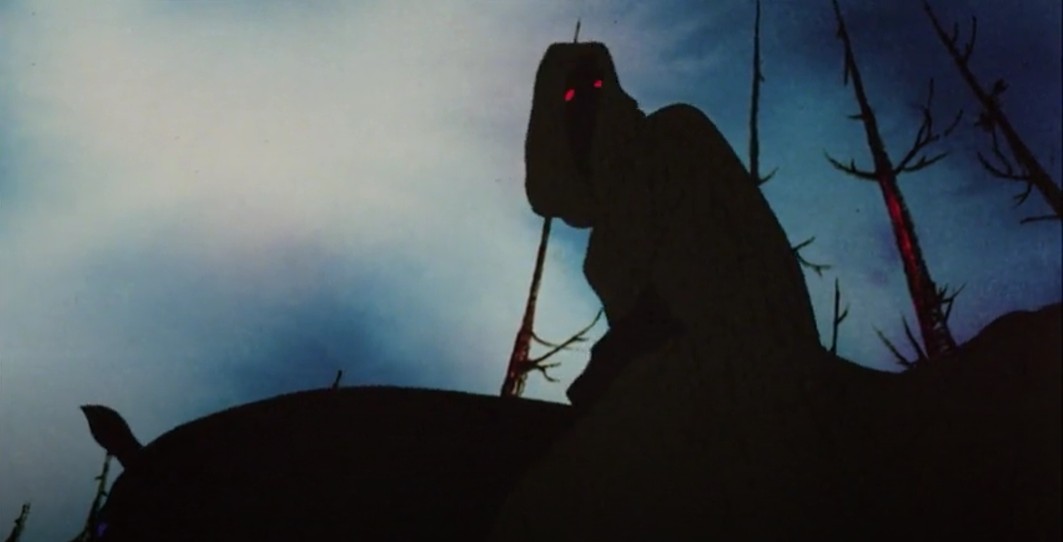
If the Rider at Bag End was acting under Khamûl’s direction—or was Khamûl himself—his cautious and investigative behavior fits well with Tolkien’s later descriptions of the Nazgûl’s search.
Reconstructing the Message
Taking all of these factors together—the Riders’ investigative approach, their uncertainty about Frodo, and their strict secrecy about the Ring—the likely shape of the message becomes clearer.
It would probably have included:
- A request for Frodo to meet or speak with the Rider.
- A suggestion that cooperation might bring some benefit or reward.
- A careful avoidance of mentioning the Ring or Sauron.
In short, the message would have been framed as a practical and neutral request, rather than a threat.
A reconstruction consistent with Tolkien’s tone might read: “Mr. Baggins, I wish to speak with you on a matter of business that may bring you great profit. I ask but a moment of your time to present my offer.”
The wording is polite and business-like, yet subtly unsettling—precisely the balance that characterizes the Nazgûl’s interactions in the early stages of their hunt.
The Gaffer’s Refusal
Ironically, it is the Gaffer’s stubborn independence that prevents this strategy from unfolding. By refusing to deliver the message, he blocks the Rider’s attempt at quiet contact.
The Rider leaves with the ominous statement that Frodo will know he has been there, turning what might have been a discreet inquiry into a sign of danger.
In this small act of defiance, the Gaffer inadvertently frustrates the Nazgûl’s plan and helps ensure that Frodo leaves the Shire before they can identify him with certainty.
Conclusion
Tolkien never reveals the exact words the Nazgûl intended for Frodo, and the ambiguity adds greatly to the tension of the story. Nevertheless, the surrounding evidence allows us to infer the likely nature of the message.
Rather than a threat, it would probably have been a carefully worded request for a meeting—perhaps even hinting at reward. It would have avoided all mention of the Ring, preserving the secrecy of Sauron’s search.
Seen in this light, the Rider’s visit to the Gaffer represents a brief glimpse into the Nazgûl’s early strategy: quiet inquiry, inducement, and patience before terror.
© 2026 Christian A. Larsen. All Rights Reserved.
 Christian A. Larsen
Leave a comment