

There are stories we discover, and then there are stories that discover us.
For me, the doorway into Middle-earth did not open through the pages of a book. It flickered to life on the silver screen, ground out frame-by-frame by a library movie projector sometime in the late 1970s. My earliest memory of consuming The Hobbit was not reading it, but watching the 1977 animated adaptation produced by Rankin/Bass Productions.
I may have seen it when it first aired—my father was already a devoted fan of J. R. R. Tolkien—but the memory that has endured is more specific and more intimate. I am sitting cross-legged on the floor of the Park Ridge Public Library. The carpet is low-pile and rough, like my dad’s face when he skipped a day of shaving. The movie projector is perched high on a rolling cart. The lights are dimmed, and on that screen: hobbits, dwarves, goblins, eagles, and a dragon whose voice could chase you into your nightmares.
To my preschool eyes, it was perfect.
Animation as Initiation
Children do not arrive at stories analytically. We do not compare adaptation choices or debate fidelity to source material. We surrender.
The 1977 animated film—directed by Jules Bass and Arthur Rankin Jr.—did not feel like an adaptation. It felt like revelation. The watercolor backgrounds, the slightly exaggerated character designs, the 24 fps movement—none of it struck me as stylistic choices. They were simply how Middle-earth was supposed to look.
Even now, decades later, when I reread the book, my mental images do not default to later cinematic interpretations. They do not belong to sprawling CGI landscapes or hyper-real battle scenes. They belong to the softer, storybook palette of that animated film. My Bilbo still carries the gentle roundness of that design. My Gollum still echoes with that peculiar rasp. My Mirkwood is painted in layered, haunted greens.
That early visual grammar shaped my imagination permanently.
Music as Myth-Maker
If the animation gave Middle-earth shape, the music gave it soul.
The soundtrack of the 1977 film—composed by Maury Laws with songs written by Glenn Yarbrough—did not merely accompany the story. It interpreted it. The melodies were melancholy, whimsical, and sometimes eerily beautiful. They carried the emotional weight of the narrative in ways my young mind could grasp long before I understood themes of greed, exile, or courage.
Music is a powerful mnemonic device. It embeds itself into memory with hooks and refrains. To this day, certain lines from those songs summon not just scenes, but sensations: the hush of the library, the scratch of carpet fibers, the feeling of being small in a very large world.
For a preschooler, music was the bridge between narrative and feeling. It told me when to be afraid. It told me when to laugh. It told me when something mattered.
Voice as Authority
Voice acting is often overlooked in discussions of adaptation, but for a child encountering a story for the first time, voice is law.
The narrator’s cadence, the dwarves’ gruff camaraderie, the oily menace of goblins—these voices defined character before I could parse dialogue. They made the world feel inhabited.
When I later encountered different interpretations—whether through radio drama or reading silently—I had to negotiate with those original voices in my head. They had become canonical for me. They were not one version among many. They were the version.
See the Pictures, Hear the Tape, Read the Book
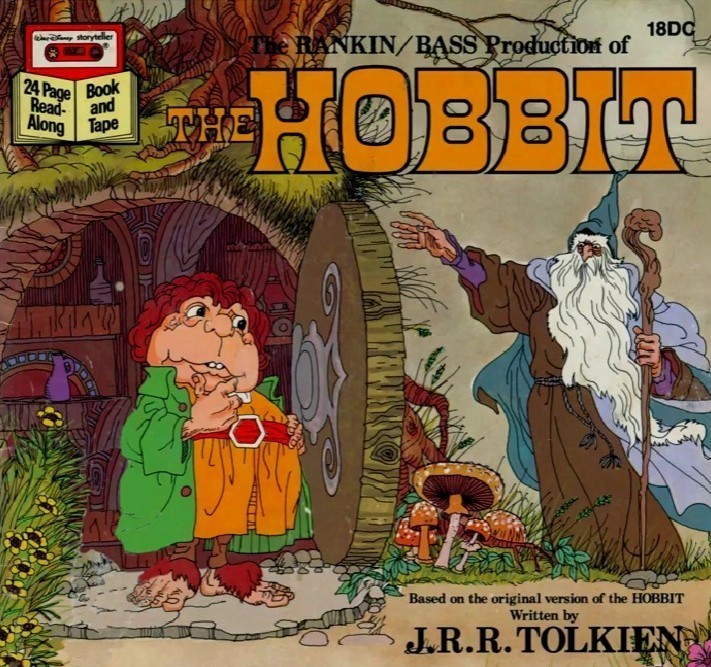
A year or two later, I received the cassette and 24-page read-along book. If the film had been initiation, this was apprenticeship.
The format was tactile and participatory. A chime told you when to turn the page. You were not merely watching; you were synchronizing. The story began to require something of you.
This transitional format was brilliant for a child. It preserved the guiding hand of narration and sound effects while introducing the discipline of text. The words were no longer incidental—they were the source. The images existed to serve them.
Without realizing it, I was being trained to read epic fantasy.
The Mind’s Eye and the Expanding Soundscape
Eventually I graduated to the NPR adaptation produced by The Mind’s Eye. This version expanded the story through audio drama—layered sound design, a fuller cast, more textured atmospherics.
By then, I was old enough to appreciate nuance. The story felt larger, deeper, perhaps darker. The world expanded beyond the watercolor frames of my first encounter.
But here is the key: I did not replace my earlier experience. I layered onto it.
Every subsequent encounter with The Hobbit—every rereading, every adaptation—has existed in conversation with that first Rankin/Bass experience. The radio drama added corridors and echoes to rooms I already knew. It did not demolish and rebuild the house.
Reading at Ten
When I finally read the book independently at age ten, it felt less like discovering a new story and more like uncovering hidden passages in a familiar landscape.
I already knew the broad contours: Bilbo’s reluctance, the riddles in the dark, the desolation of Smaug. But the prose revealed subtleties the film had not captured. Tolkien’s voice—wry, intrusive, warm—emerged more clearly on the page.
Reading the novel allowed me to encounter J. R. R. Tolkien directly, without intermediary.
And yet, even as I read, my imagination remained tinted by that 1977 palette. The songs echoed between paragraphs. The faces hovered over descriptions. The cadence of certain lines aligned with remembered narration.
Some might argue that this is a limitation—that a first adaptation can narrow imaginative freedom. I see it differently. It provided scaffolding. It gave my mind something to climb.
The Permanence of First Frames
Cognitive science tells us that early exposures create powerful anchors. The first version of a story we encounter often becomes the default template against which all others are measured.
For many younger fans, that template might be shaped by Peter Jackson’s live-action adaptations decades later. For me, it will always be animated watercolor and folk melodies drawn by Yarbrough’s trilling vibrato.
This does not mean I reject later interpretations. It means I approach them through a particular lens.
When a scene diverges from my childhood memory, I feel the difference viscerally. When it aligns, I feel affirmation. My understanding of tone—of how humorous or how dark a moment should feel—was calibrated by that first exposure.
Libraries as Portals
I often return, in memory, to that library floor.
Libraries are democratic gateways to myth. You do not need to own the book. You do not need to belong to an academic tradition. You simply sit down, cross-legged, and watch a world unfold.
There is something profoundly fitting about encountering Tolkien there. His work, after all, was born from a love of language, preservation, and shared cultural inheritance. The library is a secular cathedral of stories.
That early viewing linked Middle-earth not just to fantasy, but to public space, community, and accessibility. The story was not a private possession; it was a shared treasure.
The Role of Fathers and Fandom
My father’s fandom mattered, even if I did not fully grasp it at the time.
Children inherit enthusiasms long before they understand them. The fact that he was already a fan created an atmosphere in which Tolkien’s work was not obscure or intimidating. It was simply part of the cultural air of our household, as was my mother’s fandom of Narnia.
That context transformed my first viewing from isolated entertainment into initiation into a lineage. I was not just watching a cartoon. I was stepping into a tradition.
Adaptation as Gateway, Not Betrayal
There is a persistent anxiety among literary purists about adaptations—that they dilute, distort, or diminish original works.
My experience suggests something more generous.
Without the Rankin/Bass adaptation, I might not have approached the book so eagerly. The film lowered the barrier to entry. It translated epic prose into a format my preschool brain could process.
Adaptation, in this sense, is not betrayal. It is hospitality.
It says: Come in. Sit down. Let us tell you a story in a way you can receive right now.
Later, when you are ready, you can explore further.
The Framing Effect
When I say the Rankin/Bass version has always framed my understanding of the story, I mean something subtle.
It shaped my sense of tone. For me, The Hobbit is fundamentally a children’s story with dark undercurrents—not the other way around. It is whimsical first, perilous second. It sings before it roars.
That framing influences how I interpret Bilbo’s arc. His growth feels gentle, almost domestic, rather than operatic. The stakes feel personal before they feel geopolitical.
Because my first encounter was intimate and small-scale, the story remains intimate and small-scale in my heart, no matter how epic its implications.
Nostalgia and Critical Distance
As an adult, I can see the imperfections of the 1977 adaptation. The pacing wobbles. The animation occasionally falters. Certain scenes compress complexity.
And yet, critical distance has not eroded affection.
Nostalgia is often dismissed as sentimental, but it is also a record of formation. To critique that film without acknowledging its formative role would be dishonest.
It did not just entertain me. It built part of my imaginative architecture.
Stories as Layered Sediment
Over time, stories accumulate like geological strata. Each encounter deposits a new layer.
- Preschool: animated film.
- Early childhood: cassette and picture book.
- Later childhood: radio drama.
- Age ten: the novel itself.
- Adulthood: rereadings, discussions, scholarly essays, perhaps even debates about adaptation theory.
But the deepest layer remains the first.
It is not the most sophisticated layer. It is not the most textually faithful layer. It is the foundational one.
Why It Matters
Why devote this space to the memory of watching an animated film on a library floor?
Because origin stories matter.
Not just for heroes like Bilbo Baggins, but for readers and viewers. The way we first encounter a narrative shapes how we carry it forward. It influences what we emphasize, what we cherish, what we defend.
For me, The Hobbit is inseparable from watercolor skies and folk harmonies. It is inseparable from sitting cross-legged in a public library, small and attentive, while a world much larger than myself unfolded.
That framing has never left me, and it inspires me to this day.
And perhaps that is the quiet magic of stories: not only that they transport us to distant realms, but that they anchor themselves to specific rooms, specific carpets, specific moments in time.
Middle-earth, for me, will always begin there.
© 2026 Christian A. Larsen. All Rights Reserved.
 Christian A. Larsen
Leave a comment